
Exporting Body Care With a Chinese Fragrance House: A Scope Checklist
A Chinese fragrance house can take a body care line from brief to pallet, but only the parts of the job you actually wrote into the scope. Export work splits into roughly a dozen items, and the failures that reach a brand's desk are usually items that both sides assumed the other would handle. The checklist below is written as a scope document rather than a supplier review: for each item, what to request, who is normally accountable, and the point at which the assumption becomes expensive.
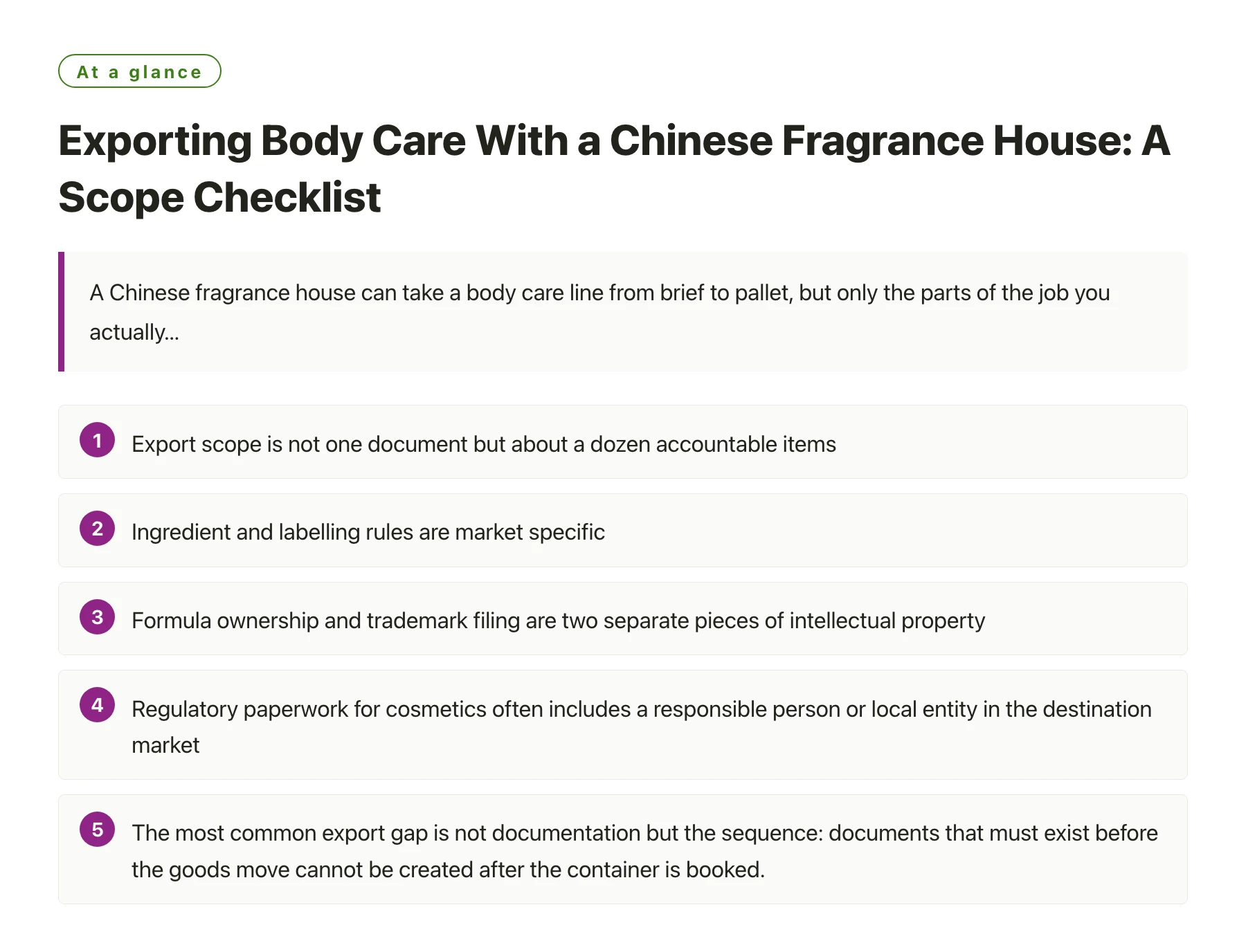
Key takeawaysExport scope is not one document but about a dozen accountable items, and each one should name an owner before the purchase order is issued. · Ingredient and labelling rules are market specific, so the destination market has to be written into the brief rather than added at the shipping stage. · Formula ownership and trademark filing are two separate pieces of intellectual property, and both should be settled in writing before bulk production begins. · Regulatory paperwork for cosmetics often includes a responsible person or local entity in the destination market, which is a brand side obligation in most arrangements. · The most common export gap is not documentation but the sequence: documents that must exist before the goods move cannot be created after the container is booked.
Brands evaluate manufacturing partners on capability and price, then discover that half of the work of exporting happens outside the factory. Registration, labelling, translation, responsible-person arrangements, transport classification and customs paperwork each sit somewhere between the brand, the factory and a third party, and the boundary is rarely obvious from a quotation.
Writing the boundary as a checklist before the first order is not administrative tidiness. It is the cheapest way to find out that a supplier does not do something, at a stage when you can still choose another route or plan for the cost.
This checklist is aimed at a body care line, because body care products are usually sold in larger volumes and in more markets than a signature fragrance, which multiplies the number of rules in play.
The export scope, item by item
| Scope item | Evidence to request | Normally owned by |
|---|---|---|
| Product specification | Written spec with measured tolerances for the finished body care product | Factory, approved by the brand |
| Safety and compliance file | Cosmetic product safety documentation appropriate to the destination market | Brand, with factory data as input |
| Ingredient and allergen declaration | Full ingredient list, allergen declaration and material documentation | Factory, reviewed by the brand |
| Label and claim review | Label copy checked against the destination market's cosmetic rules | Brand, with factory support |
| Responsible person or local entity | Named entity accepting legal responsibility in the destination market | Brand, or the brand's appointed representative |
| Product notification or registration | Confirmation of filing or listing in each destination market | Brand, often with distributor support |
| Formula ownership | Written assignment or licence terms naming the formula owner | Both parties, agreed in the contract |
| Trademark position | Search and filing status for the brand name in the destination markets | Brand, with specialist counsel |
| Batch records and certificates of analysis | Batch record plus a certificate of analysis for the shipped lot | Factory |
| Transport classification | Correct transport documentation for the finished goods and any separate fragrance compound | Factory, with the freight forwarder |
| Packing list and commercial documents | Packing list, invoice, certificate of origin where applicable | Factory and forwarder |
| Post-arrival quality check | Agreed inspection points and the remedy if results differ | Both parties, named in the contract |
Read the third column as an ownership column rather than a description: the item is only closed when the named party produces the artifact.
Where Chinese suppliers are strong, and where the brand still carries the load
Manufacturing and process documentation
The strongest reason to place body care production with an established fragrance house is that formulation, compounding and filling sit in the same organisation. That arrangement keeps the reference standard intact through the pilot and removes an entire class of handover problems, and it makes batch documentation more complete because one company owns both the lab record and the line record.
Ask for a blank batch record and a certificate of analysis template during evaluation. These tell you more about documentation discipline than any brochure.
Destination market rules remain the brand's problem
The European Commission publishes the framework for placing cosmetic products on the EU market, including the requirements that sit with the responsible person and the product information file [1]. Those obligations follow the product, not the factory, and they do not become a supplier's job because the supplier did the filling.
The practical route is to decide the destination markets at brief stage and to ask the factory which parts of the compliance pack it can produce and which it cannot. A written answer to that question should accompany the quotation.
Intellectual property is a two part question
Formula ownership and brand ownership are different assets. Ownership of a scent formula is a contract matter and can be assigned, licensed or retained, and the terms should say what happens on termination. The brand name is a trademark question, and the systems that record and protect marks internationally are matters of public record that a brand can check independently [2].
Brands that leave both questions until after a successful first run often find they are renegotiating from a weaker position, because the product is already selling.
Chemical and transport rules are not admin
Transport classification, safety data documentation and restrictions on certain substances all fall under rules that vary by jurisdiction and are periodically revised [3]. This is the item most likely to be missed, because it is nobody's favourite topic until a shipment is held.
Ask early which documents travel with the goods, who prepares them, and what the factory's standard practice is for products in your category.
Sequencing the scope so nothing is created too late
- Before the brief: choose the marketsDestination markets determine the claim vocabulary, the labelling requirements and the testing plan. Choosing them later means rework.
- Before sampling: agree the pack formatFill size, closure and label area constrain both the claim copy and the dosage, so they belong before the first submission.
- Before the pilot: confirm the compliance ownerName the responsible entity and the person who will hold the product information file for each market.
- Before bulk: settle formula terms and mark statusOwnership, exclusivity and trademark filings should be in writing at this stage rather than after a successful launch.
- Before booking freight: collect the moving documentsTransport documentation, certificates and packing lists are produced before the container is loaded, not after.
A quotation that does not say who owns the compliance work is an incomplete quotation rather than a cheaper one. Ask for the gap in writing and price it before you compare suppliers.
How to run the scope conversation
Send the checklist itself. A supplier that marks each item as ours, yours or third party has understood the exercise; a supplier that replies with a capability brochure has not. The marking takes an hour and saves a quarter of assumptions.
The broader question of how Chinese fragrance houses reach international shelves is useful context here, because it explains why some suppliers are set up for export documentation and others are not. Background on how Chinese perfumery reaches global shelves is a fair starting point for a brand that has never exported body care.
It also helps to be clear about what sets Chinese perfume brands apart on export markets, since that answer determines which scope items a house is genuinely set up to own and which it will leave with you.
When comparing manufacturers, look for one whose own description of its services matches the scope items you need covered. A partner describing itself as a contract manufacturer for perfume brands is usually comfortable with unit costing, batch documentation and repeat production, which is precisely the profile an export order needs.
Finally, keep the checklist alive after the first shipment. Export scope changes as markets are added, and the version that worked for one destination is rarely complete for the second. Reviewing it before each new market costs an afternoon; discovering the gap at a port costs considerably more.
Sources
- European Commission: Cosmetics in the EU —— The European Commission's overview of EU cosmetics rules, including the responsible person, product information file and safety report requirements.
- WIPO — World Intellectual Property Organization —— The UN agency for intellectual property; resources on industrial design and patent protection relevant to product and packaging design.
- UNEP: Chemicals and Pollution Action —— The UN Environment Programme's pages on chemicals management, including the sound management of chemicals in products.
Frequently asked questions
Can a Chinese fragrance house handle all export documentation for a body care line?
It usually handles manufacturing, batch and product documentation, and transport paperwork with the forwarder. Registration, responsible-person arrangements and claim compliance normally stay with the brand or its local representative.
Who owns the fragrance formula when a Chinese factory develops it?
Whoever the contract says. Development by a factory does not automatically transfer ownership, so the terms should state the owner, the licence and what happens on termination.
Do I need a local entity in each export market?
Some markets require a responsible person or entity established there. That is a brand side arrangement, and it is worth confirming before the label copy is finalised.
How do I verify certifications claimed by a supplier?
Ask for the current certificate with the issuing body and scope, check the certificate number with the issuer where possible, and confirm that the scope covers your product category.
What usually delays a first export shipment?
Documents created too late, particularly transport and registration paperwork, plus label copy that was not checked against destination rules. Both are avoidable with a scope review before the pilot.
Получите личную карту судьбы за 90 минут
Метод «360°» объединяет семь эзотерических систем в один отчёт — без тумана и обещаний чуда. Только конкретные ориентиры для отношений, карьеры и финансов.
Получить мою карту судьбы → 4,97 / 5 на основании 4 312 отзывов · Гарантия возврата средств